Envelope Upgrade ROI Bundle for Bloomington MN Owners
Why Bundling Exterior Upgrades Pays Off Faster in Bloomington
Bloomington homeowners face a demanding climate. Winters push past -20°F windchill, summers climb above 90°F with heavy humidity, and the freeze-thaw cycle attacks exterior materials every single year. When your home's envelope — the shell of siding, windows, and insulation that separates conditioned space from the outdoors — starts losing ground, energy bills rise, comfort drops, and deferred repairs compound. What many owners miss is that tackling these components together, rather than one at a time over several years, produces a meaningfully better return on investment. Mobilization costs get split once, contractor scheduling aligns, and the finished result performs as a unified thermal system rather than a patchwork of upgrades done in isolation.
Understanding the Envelope as a System
Your home's exterior envelope functions as a single energy barrier. Siding protects the weather-resistive barrier and sheathing beneath it. Windows and doors account for a significant share of conductive heat loss in older homes. Insulation — whether in the wall cavity, beneath continuous exterior rigid foam, or in the attic — controls the rate at which heat moves through the assembly. When one layer underperforms, the others compensate, and the result is higher utility consumption across the board.
Replacing only windows while leaving drafty, degraded siding means your new glass still sits in a frame exposed to air infiltration around the rough opening. Installing new siding without addressing wall cavity insulation leaves thermal bridging through every stud. Bundling all three eliminates these gaps in a single construction sequence, and that coordination matters enormously in a climate like Bloomington's where heating degree days regularly exceed 8,000 per year.
Labor Cost Savings from a Coordinated Project
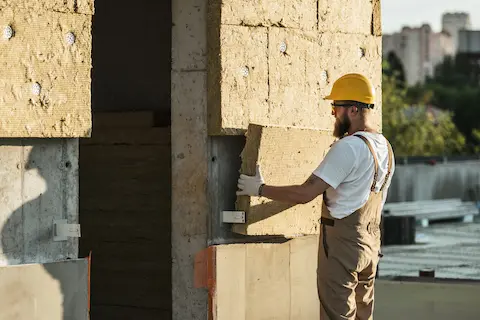
One of the most concrete financial arguments for bundling is labor efficiency. When a contractor mobilizes for a siding project, scaffolding goes up, materials are staged, and the crew is already working the exterior perimeter. Adding window replacement to that same mobilization eliminates a separate setup visit that might cost $800 to $1,500 on its own. Insulation work, especially the application of continuous rigid foam behind new siding, happens naturally during the re-cladding sequence rather than requiring a dedicated insulation contractor to return at a later date.
Industry estimates for combined envelope projects consistently show that bundling siding, windows, and insulation together reduces total labor cost by 15 to 25 percent compared with three separate single-trade projects. On a mid-range Bloomington home with 1,800 square feet of exterior, that gap can represent $2,000 to $4,500 in avoided mobilization and overlap costs alone.
Energy Payback Acceleration
The payback period on individual upgrades varies. New windows alone on an older Minnesota home might carry a payback period of 15 to 25 years based on energy savings. New insulation alone often achieves payback in 5 to 10 years. Siding replacement provides weather protection more than direct energy savings, but paired with a continuous insulation layer it contributes measurably to the thermal envelope's overall R-value.
When all three improvements happen simultaneously, the combined annual energy savings in Bloomington's climate often run 20 to 35 percent above what each improvement would contribute independently. That synergy shortens payback. A project that might individually take 12 years per component to pay back can reach combined break-even in 8 to 11 years, depending on existing conditions and chosen product tiers. If you're curious how insulation decisions interact with siding performance, this breakdown of attic insulation depth choices explains how stacking improvements compounds their financial benefit.
Product Selection That Maximizes the ROI Bundle
Not every product combination delivers equal returns. For Bloomington's climate zone 6 conditions, here are the combinations that tend to perform best:
- Insulated vinyl or fiber cement siding with integrated foam backing: Adds R-2 to R-5 to the wall assembly without requiring a separate rigid foam layer, simplifying installation and trimming material cost.
- Double or triple-pane windows with low-E coatings and argon fill: Rated for U-factor 0.27 or better, these meet Minnesota Energy Code requirements and qualify for federal tax credits available through the Inflation Reduction Act.
- Dense-pack cellulose or spray foam for wall cavities: Before new siding goes on, opening wall sections to address voided or compressed insulation adds relatively little cost when the exterior is already exposed.
- Air sealing at penetrations and window rough openings: This step costs very little in materials but contributes disproportionately to reducing infiltration, which is often a larger source of energy loss than conductive transfer in older Bloomington homes.
Local Incentives and Tax Credit Stacking
Bloomington homeowners have access to several financial tools that make the bundle approach even more attractive. Xcel Energy's Home Efficiency Rebates offer cash back on qualifying insulation and air sealing work. CenterPoint Energy provides rebates on insulation improvements for natural gas customers. At the federal level, the 25C tax credit allows homeowners to claim up to 30 percent of the cost of qualifying windows and insulation materials, with an annual cap of $1,200 for these categories. Exterior doors and certain siding products may also qualify depending on their energy performance ratings.
Stacking these programs works best when all improvements happen within the same tax year, which is another reason the bundled project approach aligns well with the incentive structure. A phased approach spread across multiple years may forfeit the ability to reach the maximum annual credit on each category. Working with a contractor familiar with Bloomington's rebate landscape helps you time submissions correctly and retain documentation for both utility and federal programs.
Choosing the Right Contractor for a Bundled Project
Not every exterior contractor has equal experience coordinating multi-trade envelope projects. You want a team that can manage siding, window installation, and insulation work under one contract or at minimum within a tightly coordinated subcontractor structure. Disjointed scheduling between trades is the most common reason bundled projects lose their cost advantage in practice.
Ask prospective contractors how they handle window rough-opening air sealing before siding closes the wall. Ask whether their siding crews are experienced with continuous insulation installation details at corners and penetrations. Ask for references from Bloomington or neighboring communities where they've completed full envelope projects, not just siding-only work. For homeowners ready to explore what a coordinated project might look like for their specific home, Energy Efficiency Upgrades covers the full range of services available in this area.
Timing Your Project in the Bloomington Market
Exterior work in the Twin Cities metro follows a compressed seasonal window. Siding and window installation requires temperatures above freezing for adhesives, caulks, and trim work to cure properly. Practically speaking, that means the workable season runs from late April through early October. Booking a bundled envelope project early in the calendar year — ideally with a signed contract by February or March — ensures your place in the contractor schedule before the busy season eliminates flexibility. It also gives time to complete energy audits, confirm product availability, and submit rebate pre-approvals where required.
Bloomington homeowners who take this planning approach consistently report smoother project execution and fewer scheduling delays than those who call in May hoping for June installation. The return on a bundled envelope upgrade is real, but only when the project actually gets completed in the window that makes sense for your household's finances and the construction season available to you.
